


21-4-2026
Beyond the Salad: Why Vegetables Deserve to Be the Main Event
The Supporting Act That Became the Lead
For most of Western culinary history, vegetables occupied a supporting role — the side dish, the garnish. This was never the case in Indian, Middle Eastern, and Mediterranean cuisines. Dhal, ful medames, caponata, ratatouille, shakshuka — these are not sides. They are the meal.
The Mistake Most Cooks Make
Vegetables fail on plates because they're treated without attention. The same cook who would never crowd their pan when searing meat will boil a huge quantity of broccoli until it's grey and waterlogged.
The principles that make meat good apply equally to vegetables:
- High heat creates browning and caramelisation that adds depth.
- Dry surfaces allow roasting and searing rather than steaming.
- Seasoning at every stage, not just at the end.
- Fat as a carrier — vegetables need olive oil or butter to develop colour and deliver flavour.
A roasted cauliflower, cut into thick steaks, brushed with olive oil, and cooked at high heat until dark at the edges, is not a side dish. It's as satisfying as many cuts of meat.
The Protein Conversation
Legumes, lentils, beans, chickpeas, tofu, eggs, dairy, and nuts all provide complete or near-complete protein. A bowl of lentil dal with a grain contains everything a body needs. The protein isn't absent — it's just not in animal form.
Chickpeas are one of the most underrated ingredients in a home kitchen. They take on spice and fat beautifully, and can be roasted into something crunchy, blended into something smooth, or left whole in a braise.
A Different Kind of Creativity
Vegetable-centred cooking invites new creativity. Without a central protein to organise everything around, you're forced to think about texture, contrast, and layering differently. All it requires is treating vegetables as if they matter — which, of course, they do.
Recept
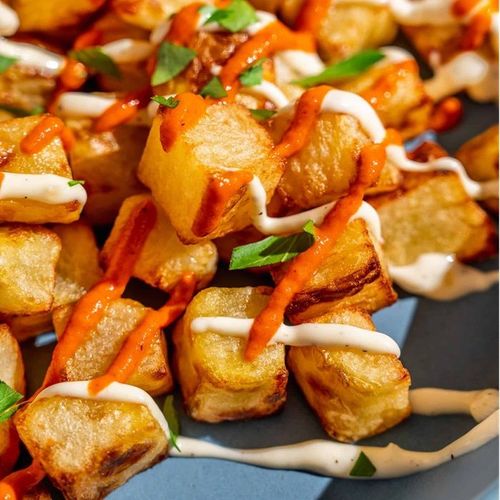
Air fryer patatas bravas
Een Spaans vegetarisch gemaakt met aardappelen, paprikapoeder en tomatenpuree.