

Dishara
EN|NL
Sign inSign up
BreakfastDessertDinnerDrinkLunchSeafoodVegetarian
What are we eating today?
Explore
  • Food stories
  • What are we eating today?
Account
Sign upSign in
EN|NL
Categories
  • Breakfast
  • Dessert
  • Dinner
  • Drink
  • Lunch
  • Seafood
  • Vegetarian
Dishara

Recipes, pantry inspiration, and kitchen stories — for cooks who like to dig in.

Browse
HomeFind a recipeWhat are we eating today?Food stories
Categories
BreakfastDessertDinnerDrinkLunchSeafoodVegetarian
Account
Sign inSign upForgot password?
Legal
Privacy PolicyTerms of serviceEnd-user agreement
Connect
Get in Touch

Email & social

© 2026 Dishara — A passion project by Stevens Design — www.stijnstevens.be

We value your privacy

We use cookies to enhance your browsing experience, serve personalised content, and analyse our traffic. Please choose your preferences below.

NecessaryAlways active

These cookies are essential for the website to function correctly. They cannot be disabled.

Show 2 cookies
NamePurposeDuration
gcb_consentStores your cookie consent preferences1 year
sessionAuthentication session tokenSession
Analytics

These cookies help us understand how visitors interact with our website, helping us improve our content and user experience.

Show 3 cookies
NamePurposeDuration
_gaGoogle Analytics — tracks unique visitors2 years
_gidGoogle Analytics — distinguishes users24 hours
_gatGoogle Analytics — throttles request rate1 minute
Marketing

These cookies are used to track visitors across websites to display relevant and engaging advertisements.

Functional

These cookies enable enhanced functionality and personalisation, such as remembering your preferences.

We value your privacy

We use cookies to enhance your browsing experience, serve personalised content, and analyse our traffic. Please choose your preferences below.

NecessaryAlways active

These cookies are essential for the website to function correctly. They cannot be disabled.

Show 2 cookies
NamePurposeDuration
gcb_consentStores your cookie consent preferences1 year
sessionAuthentication session tokenSession
Analytics

These cookies help us understand how visitors interact with our website, helping us improve our content and user experience.

Show 3 cookies
NamePurposeDuration
_gaGoogle Analytics — tracks unique visitors2 years
_gidGoogle Analytics — distinguishes users24 hours
_gatGoogle Analytics — throttles request rate1 minute
Marketing

These cookies are used to track visitors across websites to display relevant and engaging advertisements.

Functional

These cookies enable enhanced functionality and personalisation, such as remembering your preferences.

The Art of Low and Slow: Why Braised Beef Is Worth Every Minute

The Art of Low and Slow: Why Braised Beef Is Worth Every Minute

18/04/2026

Patience as an Ingredient

If cooking has taught me one thing, it's that time is the most underrated ingredient in any kitchen. Nowhere is this more evident than with braised beef. A cut that would be virtually inedible after a quick fry — short rib, chuck, brisket, shank — transforms entirely over two to three hours of gentle heat into something deeply satisfying.

Why Tough Cuts Win

The logic runs counter to what we might expect. We often reach for the most tender cuts: fillet, sirloin, ribeye. But for braises and stews, these cuts work against you. They don't have enough collagen to break down, enough fat to baste themselves, or enough connective tissue to give the liquid its characteristic body.

The "tough" cuts — the ones from muscles the animal used frequently — are exactly what we want. Short ribs have an extraordinary fat-to-meat ratio. Chuck has thick seams of connective tissue that turn the surrounding liquid silk. Brisket, once braised, pulls apart in satisfying, fibrous strands.

The Sear: Don't Skip It

Before the slow phase begins, there's an essential step that many home cooks rush: the sear. When meat hits a properly hot, dry pan, the Maillard reaction kicks in — a complex series of chemical reactions between amino acids and sugars that creates hundreds of distinct flavour compounds.

That dark, slightly caramelised crust on the outside isn't just visual. It carries depth that liquid alone cannot provide. Take your time. Use a wide, heavy pan. Don't crowd the meat. Let it sit without moving for at least three minutes before turning.

The Liquid Matters

The braising liquid is the medium through which everything happens. Bone broth, red wine, beer, tomatoes — each brings its own profile. A classic European braise leans on red wine and aromatics. A North African interpretation might introduce preserved lemon and harissa. An East Asian version could call for soy, star anise, and rice wine.

The key rule: the liquid should reach about halfway up the meat, not submerge it. You're braising, not boiling. The steam trapped under the lid does as much work as the liquid itself.

Finishing Touches

Once the meat is done — and you'll know because a fork slides in with no resistance — rest it while you reduce the braising liquid to a proper sauce. Strain it, skim excess fat, and simmer until it coats the back of a spoon. A small knob of cold butter whisked in at the end adds gloss and richness.

Braised beef rewards patience. It's forgiving in a way that a timed steak is not. Walk away. Come back. It will be exactly as you hoped.
Recipe

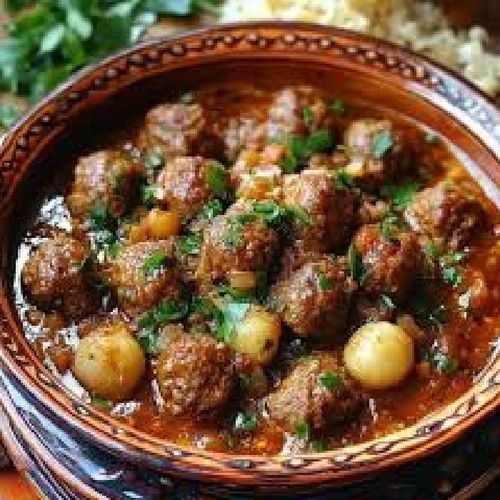
Algerian Kefta (Meatballs)

A Algerian beef made with ground beef, plum tomatoes and parsley.

See recipe